
Latest News

New article alert!
The Relationship between Lower-Body Strength and Power, and Load Carriage Tasks: A Critical Review
The purpose of this review was to critically appraise articles that have investigated the association between lower-body strength and power during load carriage in tactical personnel. Literature databases were searched with specific search terms, yielding 921 articles. Additional studies found from article reference lists were also assessed for eligibility. Out of these articles, 16 met the inclusion/exclusion criteria and were critically appraised. Articles were assessed by the Downs and Black evaluation tool with inter-rater agreement determined by Cohen’s kappa and final results graded according to the Kennelly quality grading system. Of the 940 identified articles, 16 studies met the criteria for inclusion in this review. The average score of the eligible articles was 58%, considered to be of fair quality by the Kennelly grading system. The strength and volume of evidence reviewed suggests that: measures of lower-body strength and power can predict load carriage performance and appear to be important physical factors for load carriage ability, and that load carriage tasks negatively impact the performance of leg strength and power. Together these findings suggest that leg strength and power should be important considerations for tactical personnel training and assessment, as well as managing the impact of load carriage on tactical performance.
https://digitalcommons.wku.edu/cgi/viewcontent.cgi?article=2516&context=ijes
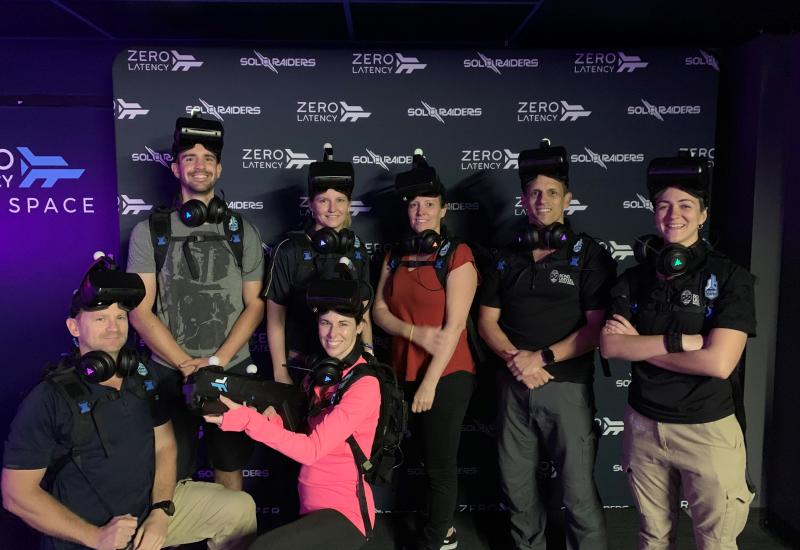
Research into stress and simulation
And so it starts. Piloting the bioharness integration with the Zero Latency ADA harness prior to a series of simulation and stress studies led by TRU’s Dr Elisa Canetti. This study will compare levels of stress in Veterans and Non Veterans exposed to an intensive simulation (Zero Latency scenarios). In addition, student stress responses from a Zero Latency zombie apocalypse will be compared to physiotherapy simulated patient assessments. Theory 1: It is better to partner up with a Vet if you want to survive the apocalypse as they will be less stressed. Theory 2: For students, facing a simulated patient exam is like facing a zombie apocalypse.
New article alert!
Effects of Sex and Age on Physical Testing Performance for Law Enforcement Agency Candidates: Implications for Academy Training
Law enforcement candidates are often required to complete fitness tests to assess their preparedness for training. This study investigated the influence of sex and age on candidate performance before academy training. Retrospective analysis of 516 candidates was performed. Data were stratified into men (n = 432) and women (n = 84), and the pooled (men and women combined) data were stratified into age groups (20-24; 24-29; 30-34; 35-39; and 40+ years). The tests included the following: maximal push-ups and sit-ups in 60 seconds; a 75-yard pursuit run (75PR); arm ergometer revolutions completed in 60 seconds; and a 2.4-km run. To compare the sex and age groups, a 2 × 5 analysis of variance (with Bonferroni post hoc for multiple between-age group comparisons) was used. Men performed significantly (p < 0.001) more push-ups, sit-ups, and arm ergometer revolutions and were faster in the 75PR and 2.4-km run. The 20-24, 25-29, and 35-39 year groups were faster in the 75PR compared with the 40+ year group; the 20-24 and 25-29 year groups were faster than the 35-39 year group; and the 20-24 year group was faster than the 30-34 year group (p ≤ 0.023). The 20-24 year group was faster than the 40+ year group in the 2.4-km run (p = 0.005). Women and older candidates may have a lower physical capacity than men and younger candidates, respectively, in certain physical assessments. Women and older candidates, in particular, may benefit from dedicated training before academy to better prepare for the demands of this period.

New article alert!

The ability of fitness testing to predict injury risk during initial tactical training: A systematic review and meta-analysis
Regardless of their role within an organization, all tactical personnel require sufficient physical fitness to be able to complete daily occupational tasks safely and effectively. One challenge faced by tactical training institutions lies in the use of physical training to increase fitness, especially in less fit trainees, when physical training itself is known to contribute to injury risk. Therefore, the aims of this review were to identify studies that have investigated associations between fitness measures and injuries, critically appraise the quality of these studies, and synthesize key findings to inform tactical organizations. Twenty-seven studies were ultimately included. Mean Critical Appraisal Skills Programme score was 10.6/12 (9-12) for cohort studies and 9.5/10 (9-10) for case-control studies. A meta-analysis was performed on publications studying a timed, fixed-distance run, reporting hazard or risk ratios categorically and the number of injuries in each group. The combined risk ratio was determined to be 2.34 (95% CI 2.02-2.70). This indicates a significant increase in risk of injury during training for personnel who performed in the slowest quartile or quintile when compared to peers in the fastest quartile or quintile, which follows given this high volume of distance weight bearing activity required by tactical personnel. Muscular endurance tests, such as pushups, sit-ups and pull-ups were less conclusive in their predictive abilities. Functional strength tests were effective predictors, but only four studies reported on a measure of strength, and only two were functional measures, indicating a need for further study in this area.

New article alert!

The validity of self-reported measures of height, body mass and BMI in a population of police officers
Abstract: Height and body mass data is often self-reported by study participants. However, the accuracy of self-reported height and body mass data compared to these same measures collected by researchers is unknown. The purpose of this study was to compare the accuracy of self-reported height and body mass data to measured values within the US law enforcement population, and the impact these estimations have on the accuracy of BMI classifications. METHODS: Self-reported and measured height and body mass data for thirty-three (n = 33) male law enforcement officers (age: 40.48 ± 6.66 yrs; measured height: 180.42 ± 6.87 cm; measured body mass: 100.82 ± 19.86 kg) were utilized for this analysis. RESULTS: Paired samples t-tests revealed no significant differences in estimated and measured height (p=.830), body mass (p = .527) or BMI (p = .623). CONCLUSION: Self-reported height and body mass was accurate for calculating BMI within this population sample. Keywords: anthropometrics; health assessment; police; obesity.
Full text here: file:///C:/Users/rorr/Work%20Folders/Downloads/21191-112327-1-PB%20(1).pdf
New article alert!
Tracking Training Load and Its Implementation in Tactical Populations: A Narrative Review
ABSTRACT: Tactical populations often participate in demanding physical training and perform strenuous workplace tasks, increasing injury risk. Mitigating injury risk is vital for maintaining trained personnel and should be a focus for tactical populations. One such method, tracking training load, has not been studied in-depth in tactical populations, despite documented effectiveness in elite sport. Most injuries to tactical personnel are overuse in nature and therefore may be prevented by optimizing training load. Although the methods used in elite sport may not be directly transferable to tactical environments, they may be used to inform injury mitigation strategies in tactical populations

New article alert!

The Effects of Body Armour on the Power Development and Agility of Police Officers
Abstract
A study was conducted in which 11 police officers wore one of three different types of Individual Light Armour Vests (ILAV), or normal station wear, for an entire day while completing power and agility-based tasks including a vertical jump (VJ), agility test, 20m sprint and counter movement jump (CMJ). Despite all three ILAVs being significantly (p<.05) heavier than normal station wear, there were no significant differences between any of the ILAVs in VJ, time to complete the agility test, 20 m sprint time, peak force, velocity, power and jump distance in the CMJ. There was a significantly (p<.05) higher mean force produced in the CMJ while wearing all three ILAVs. The ILAV’s investigated do not appear to be heavy enough to significantly affect the power or agility of police officers. The utilization of ILAVs by police officers does not appear to hinder policing tasks that involve agility or power development.
Practitioner Summary
The addition of the extra load of military styled body armour is known to decrease performance and mobility. When compared to normal station wear, the wearing of three different ILAV types used in policing don’t appear to be heavy enough to affect the power or agility of police officers.
https://www.tandfonline.com/doi/full/10.1080/00140139.2019.1648878